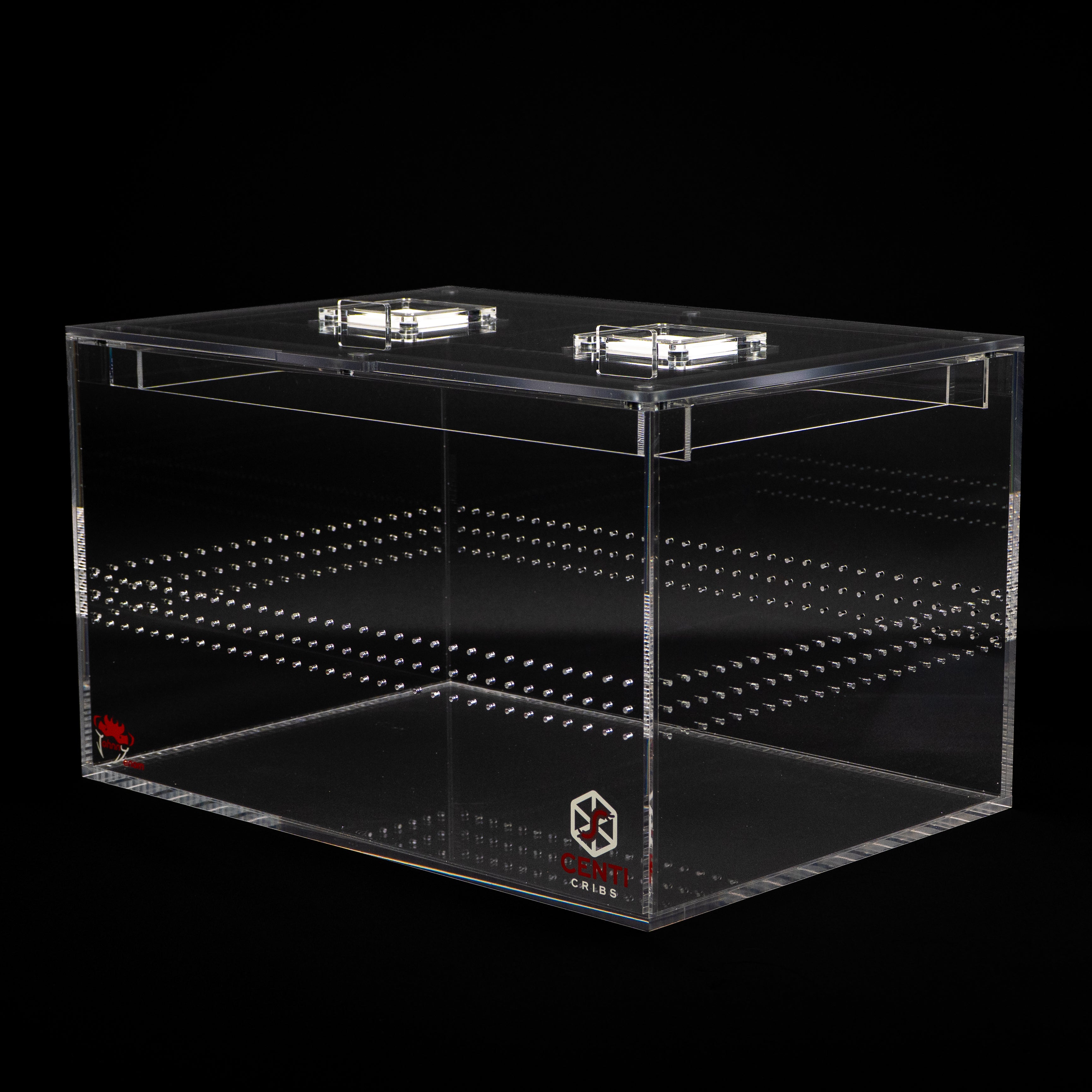
Built With Johnny Venom. Built For Species That Are Escape Artists.
Twenty units. That's the entire run (with 10 already accounted for)
This enclosure started as a build request, not a product. Johnny Venom keeps centipedes that most keepers won't touch — and he needed housing that solved the three failures that ruin a setup: escapes, stagnant air, and lids that warp until they don't seal anymore. We built it, he tested it, and this is what came out the other side.
LEAD TIME IS 6 WEEKS AT THIS POINT IN TIME. (UPDATED 9/25/26)
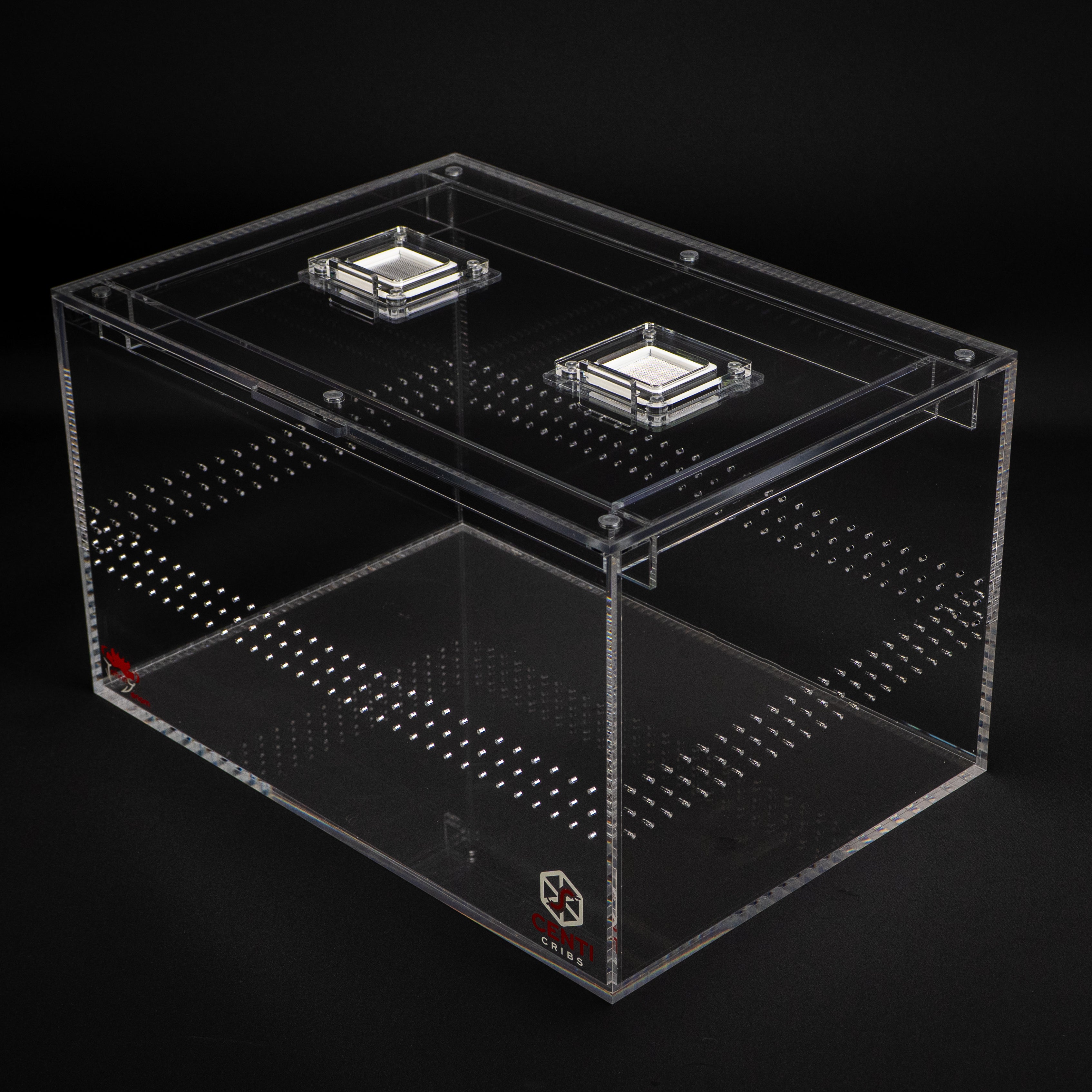
Patent-Pending Feeding Port / Fan Mount
One port, two jobs.
Drop in feeders through it, then close it. Or mount an Exo Terra® Mini Fan in the same housing and convert the port into an active air-movement system. No drilling, no adapters, no aftermarket bracket kits. The port and the fan mount are the same component — a design we've filed patent applications on.
Twin ports, positioned on opposite ends of the lid, so you can run active intake and exhaust across the full 20-inch length instead of stirring air in one corner.
Exo Terra® Mini Fan sold separately. Exo Terra® is a registered trademark of Rolf C. Hagen Inc. Centi Cribs is not affiliated with, endorsed by, or sponsored by Rolf C. Hagen Inc.
Patent-Pending Escape-Barrier Rim
A see-through interior panel runs the full perimeter of the enclosure, seated below the lid line.
Centipedes escape at the seam. Not through the mesh, not through the walls — at the gap where lid meets wall, using the flat vertical surface to bridge across. The rim panel eliminates that transition. It's clear, so you lose nothing in viewing, and it's a structural part of the build, not a strip of foam you replace every six months.
This is the second component we've filed patent applications on.
Low-Mount Cross Ventilation
The ventilation banks sit low, at substrate level, on all four walls.
Why low: Damp substrate develops a stagnant boundary layer of humid, still air directly above it. That layer is where mold blooms, where grain mites establish, and where an otherwise healthy setup starts to fail. Low intake vents combined with lid-level exhaust create passive convective airflow — air enters low, warms, rises, and exits through the lid. The substrate stays moist. The air above it does not sit still.
High-only ventilation dries the top and does nothing for the layer that matters. Low-mount cross ventilation is why this design holds humidity and stays clean.
Hundreds of precision-drilled ports per wall, sized to retain humidity while permitting continuous exchange.
Magnetic Lid, Warp-Resistant Build
Strong magnetic closure at every corner and midpoint. No latches to fatigue, no clips to snap, no tape.
The lid is engineered against warping — the failure mode that turns a secure enclosure into an open one over time. Acrylic lids that flex under humidity cycling lift at the center and open a gap you won't notice until the animal is gone. This one holds flat.
Premium Thick-Wall Acrylic
Heavy-gauge cast acrylic throughout. Optically clear, chemically stable, and rigid enough that the walls don't bow under substrate load.
Acrylic over glass for one reason: thermal performance. Acrylic has roughly 1/5 the thermal conductivity of glass, which means it holds ambient heat far more stably — a meaningful advantage for tropical Scolopendra species that suffer from temperature swings.
Specifications
|
|
| External dimensions |
20" L × 13.5" W × 12" H |
| Floor space |
270 sq in |
| Approx. volume |
~53 L / ~14 gal equivalent |
| Material |
Premium thick-wall cast acrylic |
| Lid |
Magnetic closure, warp-resistant |
| Ventilation |
Low-mount cross ventilation, four walls |
| Ports |
2× patent-pending feeding port / fan mount |
| Fan compatibility |
Exo Terra® Mini Fan (sold separately) |
| Escape barrier |
Patent-pending see-through perimeter rim panel |
| Substrate depth capacity |
Deep-burrowing suitable |
| Production run |
20 units total |
Who This Is For
Expert keepers. Specifically: people housing large, fast, or high-value Scolopendra and comparable species where an escape is a genuine safety incident, not an inconvenience.
Centipedes are venomous animals. Envenomation from large species causes severe pain and, in some cases, requires medical attention. This enclosure is built to a security standard appropriate to that reality — but no enclosure substitutes for experienced handling practice.
If this is your first centipede, start elsewhere. This one's for keepers who already know exactly why every one of these features exists.
Limited run — 20 units. Next Run: about 2 months away.